
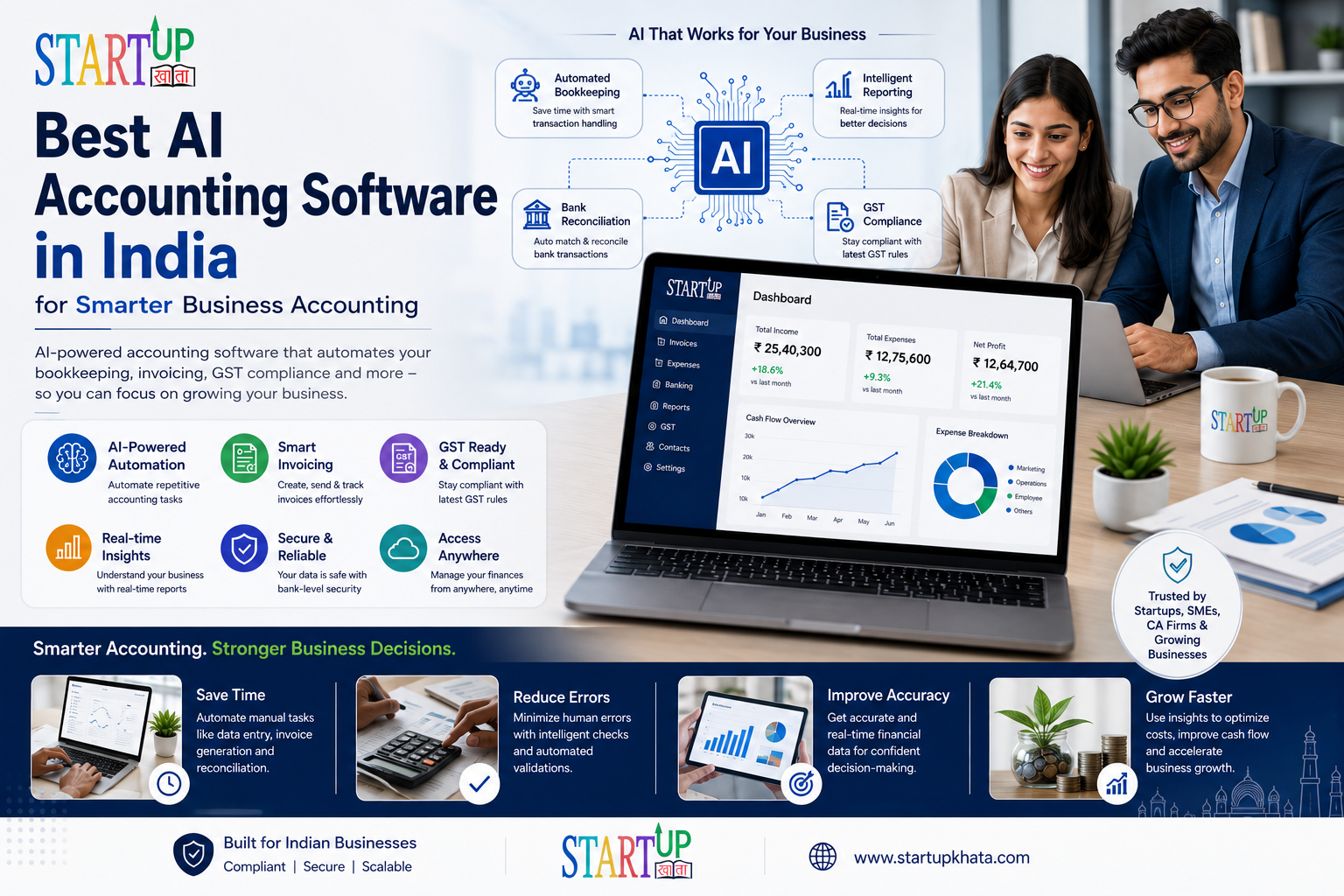
Accounting is no longer limited to maintaining ledgers, recording transactions, and preparing financial reports manually. As Indian businesses become increasingly digital, artificial intelligence is transforming the way companies manage their financial operations. From automated bookkeeping and invoice processing to financial insights and reconciliation, AI is helping businesses reduce repetitive work and make accounting more efficient.
For startups, MSMEs, growing companies, and modern finance teams, choosing the right AI Accounting Software in India can be an important step toward building a faster and more organized financial workflow. Instead of depending entirely on spreadsheets and manual data entry, businesses can use intelligent accounting technology to automate routine processes, improve accuracy, and gain better visibility into their finances.
Why AI Is Changing Accounting in India
Traditional accounting processes often require significant manual effort. Finance teams may need to enter transaction details, organize invoices, reconcile accounts, monitor expenses, prepare reports, and keep financial records updated. As transaction volumes increase, managing these activities manually can become increasingly difficult.
Artificial intelligence introduces automation into these workflows. AI-powered accounting systems can help businesses process financial information, identify patterns, organize data, and support repetitive accounting tasks. This allows finance professionals to spend less time on routine administrative activities and more time on analysis, planning, and business decision-making.
The growth of digital payments, e-invoicing, GST compliance, online banking, and cloud-based business operations has further increased the need for intelligent accounting solutions. Businesses are generating more financial data than ever, and AI can help convert that data into useful and actionable information.
This is why demand for the Best AI Accounting Software in India is growing among businesses that want to modernize their accounting processes without adding unnecessary complexity to their operations.
What Makes AI Accounting Software Different?
AI accounting software goes beyond simply storing financial information. Traditional accounting systems primarily depend on users to enter and organize data, whereas AI-powered platforms can automate several repetitive activities and assist users in managing financial information more intelligently.
For example, an AI-powered system can help organize transaction data, automate invoice-related workflows, identify discrepancies, support reconciliation, and provide financial insights based on available information. These capabilities can reduce the administrative burden on accounting teams while improving the consistency of financial processes.
Another major advantage is the ability to centralize financial operations. Instead of managing invoices, expenses, transactions, reports, and accounting information across different files and applications, businesses can bring these workflows into a connected digital environment.
For modern businesses, this means accounting can become a continuous and automated process rather than something that requires extensive manual attention at the end of every reporting period.
Benefits of Using AI Accounting Software in India
One of the biggest advantages of AI accounting technology is automation. Businesses perform many accounting activities repeatedly, including transaction recording, invoice management, expense tracking, and reconciliation. Automating these processes can save valuable time and allow accounting professionals to focus on higher-value responsibilities.
Accuracy is another important benefit. Manual data entry can lead to errors, particularly when finance teams are handling large numbers of transactions. Intelligent accounting systems can help reduce repetitive data-entry requirements and create more standardized workflows.
AI can also improve financial visibility. Businesses need timely information to understand revenue, expenses, cash flow, outstanding payments, and overall financial performance. With centralized reporting and real-time information, business owners can make decisions based on current financial data instead of relying on outdated spreadsheets.
For startups and small businesses, this can be particularly valuable. They often have limited finance resources but still need professional accounting processes. An Online AI Accounting Software in India can provide access to modern accounting capabilities without requiring businesses to build large administrative teams.
AI-Powered Bookkeeping for Modern Businesses
Bookkeeping is one of the areas where AI automation can create a significant difference. Traditional bookkeeping involves recording transactions, categorizing expenses, maintaining records, and ensuring that financial information remains organized.
AI-powered bookkeeping can simplify these processes by helping businesses manage financial information through automated workflows. Instead of spending hours entering and organizing every transaction manually, businesses can use intelligent systems to reduce repetitive tasks and maintain more structured financial records.
This does not eliminate the importance of accountants or finance professionals. Instead, it allows them to work more efficiently. Professionals can review information, handle exceptions, analyze financial performance, and provide strategic guidance while technology manages routine processes.
This combination of human expertise and AI automation is becoming an important model for the future of accounting in India.
AI and GST Compliance
GST compliance is another area where technology can help businesses improve financial workflows. Indian businesses need to manage invoices, transactions, tax information, reconciliations, and filing-related activities accurately. Managing these processes manually can create additional pressure for finance teams.
AI-powered accounting platforms can help organize relevant financial information and support GST-related workflows. Automated reconciliation can help identify potential mismatches between records, while centralized invoice and transaction management can make financial information easier to review.
Businesses should still ensure that their GST processes are reviewed appropriately and remain aligned with current regulatory requirements. AI software should be considered a technology tool that supports accounting and compliance workflows rather than a replacement for professional financial judgment.
For businesses handling a large number of transactions, however, automation can make GST-related accounting significantly more manageable.
Why Online AI Accounting Software Is Becoming Popular
Cloud-based technology has changed how businesses access software. Instead of installing accounting applications on individual computers, companies can use online platforms that provide centralized access through the internet.
An Online AI Accounting Software in India can be particularly useful for businesses with remote teams, multiple locations, or flexible working arrangements. Authorized users can access relevant financial information from different locations while maintaining a centralized system.
Cloud-based accounting can also make collaboration easier. Business owners, accountants, finance teams, and other authorized users can work with the same financial information instead of exchanging multiple versions of spreadsheets and documents.
This creates a more connected accounting environment and reduces the possibility of information becoming outdated across different systems.
Choosing the Best AI Accounting Software in India
Choosing the right AI accounting platform requires more than comparing features. Businesses should evaluate whether the software is suitable for their industry, business size, accounting workflow, and future growth.
Ease of use is an important consideration. AI technology should simplify accounting rather than make it more complicated. A good platform should have an intuitive interface that allows users to understand their financial information and complete routine activities efficiently.
Automation capabilities are equally important. Businesses should look for technology that can reduce repetitive accounting work and connect different financial workflows. Invoice management, bookkeeping, reconciliation, reporting, expense management, and GST-related processes should ideally work together rather than exist as disconnected functions.
Security should also be a priority because accounting systems handle sensitive financial information. Businesses should evaluate access controls, data protection practices, authentication, and other security features before choosing a platform.
Scalability is another consideration. The accounting requirements of a startup with ten employees can be very different from those of a growing organization with hundreds of employees. The Best AI Accounting Software in India should be capable of supporting business growth without forcing companies to completely replace their accounting systems as their requirements evolve.
How AI Accounting Supports Business Decision-Making
Accounting is not only about recording what has already happened. Financial information plays a critical role in deciding what a business should do next.
AI-powered accounting systems can help businesses analyze financial information more efficiently. When revenue, expenses, transactions, invoices, and other financial data are organized within a centralized platform, business owners can gain clearer visibility into their financial position.
This can help organizations identify spending patterns, monitor business performance, understand outstanding payments, and evaluate financial trends. Better financial visibility can support more informed decisions around budgeting, cash flow management, hiring, expansion, and investment.
For entrepreneurs, this is one of the biggest advantages of moving from traditional accounting to intelligent accounting automation. Instead of simply maintaining records, businesses can use their financial data as a tool for growth.
AI Accounting for Startups and MSMEs
Startups and MSMEs are increasingly adopting digital tools to compete in a fast-changing business environment. However, many smaller organizations operate with limited financial and administrative resources.
AI accounting software can help these businesses establish professional accounting workflows without creating excessive manual overhead. Automated invoicing, bookkeeping, reconciliation, expense tracking, reporting, and financial insights can help small teams manage more work efficiently.
For startups, automation can also create a strong foundation for future growth. As transaction volumes and employee numbers increase, businesses already have structured financial processes in place instead of relying on increasingly complicated spreadsheets.
This makes AI accounting particularly relevant for India's growing startup and MSME ecosystem.
The Future of AI Accounting in India
The future of accounting is moving toward greater automation, intelligence, and integration. AI will increasingly become part of everyday financial workflows, helping businesses process information faster and identify opportunities and potential issues more effectively.
Future accounting platforms are likely to connect accounting with broader business functions such as payroll, banking, invoicing, taxation, expense management, analytics, and financial planning. This will create a more unified approach to business management.
The goal is not simply to automate accounting for the sake of automation. The real objective is to reduce repetitive work, improve financial visibility, minimize avoidable errors, and give businesses more time to focus on growth.
As Indian businesses continue adopting digital technology, AI-powered accounting will become increasingly important for organizations that want to operate efficiently and remain competitive.
Why StartupKhata for AI-Powered Accounting?
StartupKhata is designed around the changing needs of modern businesses that want to move beyond traditional, manual accounting processes. By combining accounting automation with intelligent technology, StartupKhata aims to help startups, MSMEs, and growing businesses simplify their financial workflows.
From smart invoicing and bookkeeping to GST-related processes, reconciliation, reporting, and financial visibility, an integrated accounting environment can help businesses manage their finances in a more organized way.
For organizations searching for Top AI Accounting Software in India, the focus should ultimately be on finding a solution that combines automation, usability, scalability, security, and practical business value. Technology should make accounting easier to manage while giving business owners greater control over their financial information.
Conclusion
AI is transforming accounting from a largely manual administrative function into a smarter and more automated business process. With intelligent bookkeeping, automated workflows, digital invoicing, reconciliation support, GST-related capabilities, and real-time financial insights, businesses can manage their finances more efficiently.
Choosing the right AI Accounting Software in India can help organizations save time, improve accuracy, and gain better visibility into their financial operations. For startups, SMEs, and growing businesses, an Online AI Accounting Software in India can also provide the flexibility required to manage modern, digitally connected teams.
As businesses continue to evolve, accounting technology will evolve with them. The future belongs to businesses that do not simply record financial data but use intelligent technology to understand it, automate it, and turn it into better decisions.