
Accounting has changed significantly over the last few years. Earlier, business owners depended heavily on spreadsheets, physical registers, manual invoice entries and accountants to keep financial records updated. Today, businesses are increasingly moving toward cloud-based accounting and automated financial workflows.
In 2026, TOP AI Accounting Software In 2026 is becoming an important part of this transformation. Instead of simply recording transactions, modern accounting platforms can automate repetitive processes, organize financial information, assist with reconciliation and provide businesses with faster access to useful financial data.
For Indian businesses, the need is even more specific. Accounting software must work with GST billing, invoices, payments, inventory, bank transactions and compliance-related workflows. A solution that combines these activities can help businesses spend less time managing routine accounting work and more time focusing on customers and growth.
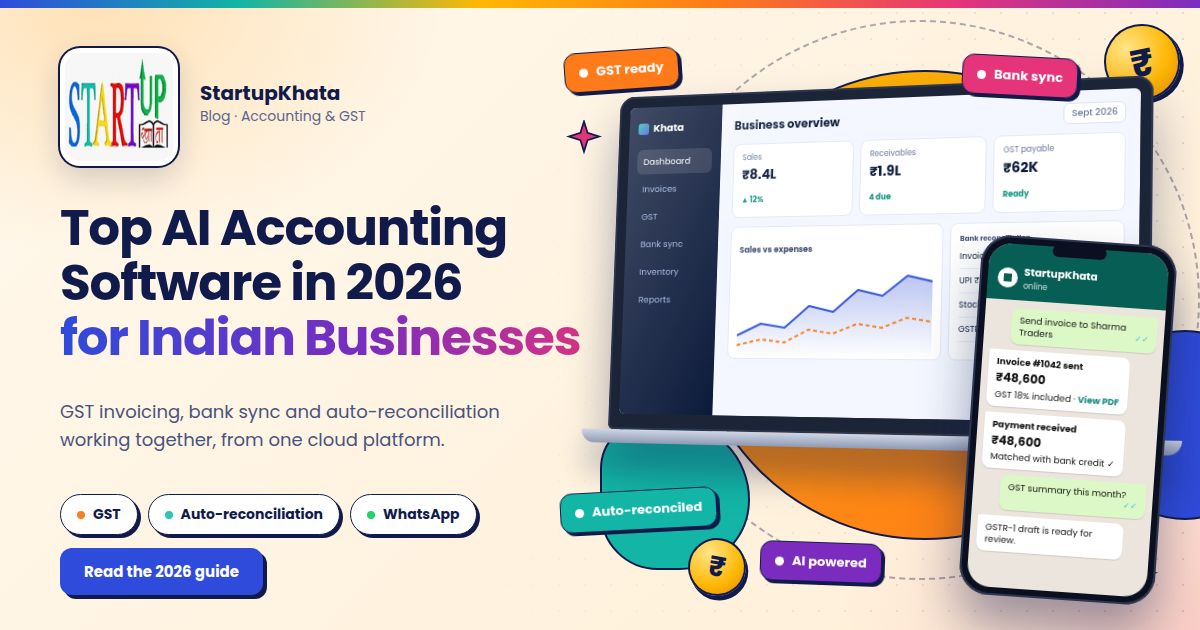
StartupKhata is built around this approach, bringing accounting, GST, invoicing, inventory and business automation together in one platform. Its current platform also provides AI-powered automation, bank synchronization, automated reconciliation and WhatsApp-based accounting and GST workflows.
What Is AI Accounting Software?
AI Accounting Software combines traditional accounting functionality with artificial intelligence and automation.
Traditional accounting software primarily helps businesses record and organize financial transactions. AI-powered systems go a step further by automating repetitive activities, processing business information and helping users identify patterns or exceptions within financial data.
For example, instead of manually checking every bank transaction against accounting records, an automated system can assist with reconciliation. Similarly, invoice and GST-related information can be connected with accounting workflows rather than being entered repeatedly into different systems.
The purpose is not to eliminate accountants or financial professionals. Instead, AI can reduce repetitive administrative work so that business owners, accountants and finance teams can spend more time on analysis, planning and decision-making.
This shift is particularly useful for startups, retailers, wholesalers, distributors, freelancers and MSMEs that need professional financial management without creating unnecessarily complicated workflows.
Why Businesses Are Moving Toward AI Accounting Software in 2026
Modern businesses generate financial information continuously. Every sale, purchase, expense, payment, refund and bank transaction adds another piece of information that needs to be recorded correctly.
When this information is managed manually, even a growing small business can end up with multiple spreadsheets, invoices, payment records and separate accounting files.
AI-powered automation can bring these processes into a more connected workflow.
Imagine a retailer receiving hundreds of transactions every month. Instead of manually entering every transaction, checking payment status and then separately updating financial records, connected software can automate significant parts of this process.
The benefit is not simply speed. Better-organized data can also give business owners clearer visibility into sales, expenses, receivables, cash flow and overall financial performance.
That is why the demand for AI Accounting Software in 2026 is closely connected with a broader shift toward digital business management.
What Should You Look for in the Best AI Accounting Software in 2026?
Searching for the Best AI Accounting Software in 2026 should not be about choosing software simply because it has “AI” written on its website.
The important question is: What can the software actually automate for your business?
A useful accounting platform should make everyday financial management easier rather than adding another complicated system to your workflow.
For Indian businesses, GST and invoicing are particularly important. The software should support business billing requirements while keeping accounting information connected with sales and purchases.
Bank reconciliation is another important area. When transactions from bank statements can be imported and matched with accounting records, businesses can reduce repetitive checking and get a clearer view of their actual financial position.
Inventory management is equally important for retailers, wholesalers and product-based businesses. Sales, purchases and stock are closely connected with accounting, so keeping them within a connected system can reduce duplicate data entry.
Reporting is also essential. Business owners need more than a list of transactions. They need to understand sales performance, expenses, outstanding payments, profitability and other financial indicators.
Finally, accessibility matters. Cloud-based accounting allows businesses to access their information from different devices instead of depending entirely on one computer.
Online AI Accounting Software in India 2026
The rise of Online AI Accounting Software in India 2026 reflects how businesses themselves are becoming more digital.
Business owners may need to check invoices while travelling, monitor payments from their phones, communicate with customers through WhatsApp or review financial information outside the traditional office environment.
Cloud-based accounting makes this possible by keeping business information accessible through connected devices.
StartupKhata positions itself as an AI-powered cloud accounting platform for Indian startups, SMEs and modern businesses. Its platform combines accounting and invoicing with GST, bank synchronization, reconciliation and other business-management functions.
This type of connected approach can be particularly useful for businesses that do not want separate tools for billing, accounting, inventory and financial reporting.
AI Accounting Software vs Traditional Accounting
The biggest difference between traditional and AI-powered accounting is not necessarily the accounting principles themselves. The difference is how much repetitive work can be automated around those principles.
In a traditional workflow, an employee may receive an invoice, read the information, enter it into software, update the ledger, check the payment and later reconcile the transaction with a bank statement.
With automation, several of these activities can become connected workflows.
The result is a shift from:
Enter → Check → Re-enter → Reconcile
toward:
Capture → Automate → Review → Report
This does not mean every accounting task should be completely automated. Financial information still needs appropriate review, especially when dealing with compliance, unusual transactions or business-specific accounting decisions.
The goal is to reduce unnecessary manual work while keeping the business owner or accounting professional in control.
How StartupKhata Uses AI and Automation for Business Accounting
StartupKhata brings several business functions together instead of treating accounting as an isolated activity.
The platform provides accounting and bookkeeping tools along with GST, invoicing, payments, inventory and business automation. It also highlights AI-powered automation, auto-reconciliation and bank synchronization as part of its accounting ecosystem.
For businesses, this can create a more connected financial workflow.
A sale can begin with an invoice. That transaction can then connect with payment tracking and accounting records. Purchases can connect with inventory and financial information. Bank transactions can be synchronized and reconciled. GST-related workflows can be managed alongside the underlying business data.
StartupKhata also promotes WhatsApp-based billing and GST workflows, allowing businesses to interact with accounting processes through a familiar communication channel.
The idea is simple: instead of making business owners move between multiple disconnected tools, bring important financial operations closer together.
Benefits of Using AI Accounting Software for Indian Businesses
One of the biggest advantages is reduced repetitive work. Accounting teams can spend less time performing repetitive data-entry tasks and more time reviewing financial information.
Another benefit is better visibility. When sales, purchases, expenses, payments and accounting information are connected, business owners can understand what is happening financially without waiting for multiple separate reports.
AI and automation can also support faster reconciliation. Matching bank transactions with accounting records manually can consume considerable time as transaction volume increases. Automated reconciliation can reduce this workload while allowing users to review exceptions.
For GST-focused businesses, integrated billing and accounting can also make financial workflows more organized. Instead of maintaining completely separate information for invoices and accounts, businesses can manage connected records from one platform.
There is also the benefit of accessibility. Cloud-based software can allow authorized users to access business information without being tied to a particular physical location.
Most importantly, AI accounting can help small businesses operate with greater structure as they grow. A business may begin with a few invoices and simple bookkeeping, but its financial operations become more complex as sales, employees, customers and suppliers increase.
Who Can Use AI Accounting Software?
AI accounting solutions can be useful for a wide range of Indian businesses.
A small retailer can use the platform to manage billing, inventory and accounts. A wholesaler can connect purchases, sales, stock and customer payments. A distributor can manage multiple transactions and monitor receivables. Startups can use cloud accounting to keep their financial operations organized as they scale.
Freelancers and service businesses can also benefit from organized invoicing, expense tracking and payment management.
For growing companies, automation becomes increasingly valuable because the amount of financial data grows alongside the business.
StartupKhata specifically positions its platform for startups, SMEs and Indian businesses looking for integrated accounting and business-management workflows.
Is AI Accounting Software Difficult to Use?
A common concern among small business owners is that advanced technology may require advanced accounting or technical knowledge.
Modern platforms are increasingly designed around simpler interfaces and automated workflows.
The objective should be to make accounting easier to manage, not to force business owners to become technology experts.
For example, StartupKhata provides accounting features alongside automated GST, billing, reconciliation and other workflows, with the stated goal of simplifying financial management for businesses.
However, businesses should still evaluate software based on their actual requirements. Features, integrations, support, pricing, compliance needs and workflow suitability should all be considered before choosing a platform.
The Future of AI Accounting in India
Accounting software is moving beyond simply storing financial records.
The next stage is about making financial information more connected, accessible and useful.
AI can help automate repetitive tasks, identify unusual information, organize financial data and provide business insights. Cloud technology makes that information accessible across devices, while integrations can connect accounting with banking, billing, inventory and other business operations.
For Indian businesses, GST and digital payments make this evolution particularly relevant. As businesses generate more transactions and financial data, manual processes become increasingly difficult to maintain efficiently.
The future of accounting will therefore likely involve a combination of human expertise + automation + intelligent software.
AI does not replace the need for financial judgment. Instead, it can help businesses spend less time on repetitive administration and more time understanding what their numbers actually mean.
Why StartupKhata Can Be Part of Your 2026 Accounting Strategy
Choosing accounting software is ultimately a business decision.
The right platform should fit the way your business sells, purchases, receives payments, manages inventory and handles accounting.
StartupKhata brings these functions into a connected platform with AI-powered accounting and automation. Its current offering includes accounting, GST, invoicing, bank synchronization, auto-reconciliation, inventory-related capabilities and WhatsApp-based financial workflows.
For businesses looking to move away from disconnected spreadsheets and repetitive manual accounting processes, an integrated platform can provide a more structured way to manage everyday finances.
Instead of asking only, “Which software has AI?”, businesses should ask:
“Which software can actually remove repetitive work from my accounting process?”
That is the question that matters in 2026.
Final Thoughts
AI Accounting Software in 2026 is becoming less about futuristic technology and more about solving everyday business problems.
Businesses need accurate records, faster invoicing, organized GST workflows, payment visibility, bank reconciliation, inventory management and useful financial reports. AI and automation can connect these activities and reduce the amount of repetitive work required to manage them.
The Best AI Accounting Software in 2026 will ultimately depend on the individual business, its size, industry, accounting requirements and workflow. For Indian businesses, GST capabilities, invoicing, banking, reporting, accessibility and automation should all be part of the evaluation.
With an integrated platform such as StartupKhata, businesses can bring accounting, GST, invoicing, inventory and automation closer together and build a more organized financial workflow.
Ready to move from manual accounting to smarter business management?
Explore StartupKhata and discover how AI-powered accounting and automation can simplify your everyday financial operations.